

Most Shopify merchants put almost all their energy into getting more traffic. More ad spend, more campaigns, more reach. But the merchants are consistently growing revenue? A lot of them are doing something different — they’re getting more out of every customer already on their site.
That’s what average order value (AOV) optimization is about. No extra traffic. No new customer acquisition. Just a store built to make spending more feel like the natural thing to do.
This playbook breaks down three of the highest-impact AOV levers available to Shopify merchants: store design, promotions, and gifts. Each one works on its own. When you run all three together, the effect compounds.
Why Most Shopify Merchants Leave AOV on the Table?
Traffic gets all the attention because it’s visible. Sessions in the dashboard, ad spend tracked, and click-through rates watched. AOV is quieter — but the math is hard to argue with.
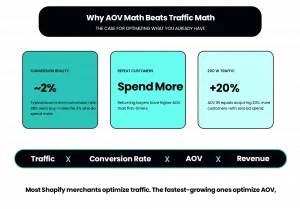
A few numbers that put it in perspective:
- According to Statista, the ecommerce conversion rates of online shoppers from 1st Quarter 2025 to 1st Quarter 2026 typically land between 1.4% to 2.6%. That means the vast majority of traffic won’t buy, no matter what. The customers who do convert should spend as much as possible.
- Repeat customers consistently spend significantly more per order than first-time buyers — which means AOV improvements hit hardest on the segment most likely to come back.
- Increasing AOV by 20% on the same traffic is roughly equivalent to acquiring 20% more customers — with zero additional ad spend.
The three levers that move AOV most reliably: how the store looks, what promotions are running, and what’s being offered for free.
Lever 1: Store Design That Nudges Bigger Baskets
Store design is not just about aesthetics. The way products are presented, grouped, and recommended directly shapes how much a customer spends. This is one of the most underused AOV tools on Shopify — and it doesn’t require a promotion or a discount to work.
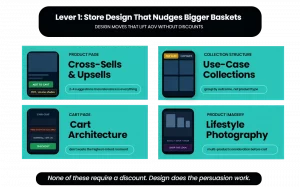
What actually moves the needle at the design level:
- Product page cross-sells and upsells. Show complementary products on every product page — not buried in the footer, but placed inside the buying flow. “Frequently bought together” placements at mid-page significantly outperform those pushed below the fold. Keep it to two to four suggestions — more than that feels overwhelming and starts to erode trust rather than build basket size.
- Collection page structure: Build collections around use cases, not product categories. “The Full Morning Routine” surfaces multiple products that belong together far more effectively than a page labeled “Serums.” When customers shop by outcome, they naturally consider more items.
- Cart page architecture. The cart is the highest-intent moment in any session. A customer who has added something to their cart is already in a buying mindset — that’s exactly when a relevant add-on, a free shipping progress bar, or a low-cost item they might have missed can change what they spend. Most stores waste this moment with a plain subtotal and a checkout button. Don’t be like most stores.
- Contextual product imagery, lifestyle images showing products in use alongside complementary items — a bag styled with accessories, a supplement photographed next to the shaker it pairs with — increase multi-product consideration before the customer even reaches the cart. People buy what they can picture.
Cross-sells that aren’t contextually relevant don’t increase order value — they feel spammy and reduce trust. Relevance is everything here.
Lever 2: Promotions That Increase Spend Without Killing Margin
Most merchants hear “promotion” and immediately think of discounts. But the most effective AOV promotions aren’t discount-first. They’re incentive-first — giving customers a clear reason to spend more, rather than just paying less for what they were already going to buy.
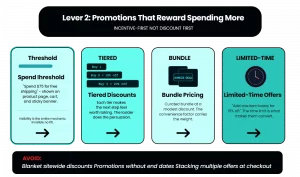
Promotion structures that consistently work:
- Spend thresholds for perks, “Spend $75 for free shipping” or “Spend $100 to get 15% off your order,” are among the most reliable AOV drivers in ecommerce. The key is visibility — the threshold needs to show up on the product page, in the cart, and ideally in a sticky banner at the top of the site. If customers don’t see it until checkout, it’s too late to change their behavior.
- Tiered discounts: “Buy two, get 10% off. Buy three, get 20% off.” Each tier makes the next step feel worth taking. A customer planning to buy one item will often buy two once they see how close they are to the next reward. The ladder structure does the persuasion work on its own.
- Bundle pricing: A curated bundle at a modest discount removes decision friction and increases per-order revenue in one move. The bundle price should feel like a deal compared to buying items separately — but the discount doesn’t need to be large. The convenience factor carries most of the weight.
- Limited-time AOV offers, “Add one more item today and get 10% off your entire order,” create urgency without permanently discounting the catalog. These work particularly well during high-traffic windows or as part of a post-add-to-cart flow. The time limit is what makes them convert.
What to be careful with:
Blanket sitewide discounts train customers to wait for sales and compress margin across the entire catalog. Promotions without a clear end date lose urgency — which is usually their only real conversion driver. Stacking multiple promotions at once makes checkout confusing, which increases abandonment rather than AOV.
Before the next promotion goes live, one question worth asking: Does it reward customers for spending more, or does it just discount what they were already going to buy? That one filter rules out most of the margin-killing moves.
Lever 3: Free Gifts That Make Spending More Feel Like Getting More
The free gift mechanic is one of the most psychologically effective tools available to Shopify merchants. It reframes the spending decision entirely — instead of “I’m paying more,” the customer thinks “I’m getting more for what I’m already spending.” That shift is the whole game.
This is where a tool like BOGOS becomes genuinely useful. BOGOS is a Shopify app that automates gift-with-purchase rules — trigger conditions (spend thresholds, specific product combinations, cart contents) are set once and it handles the rest. No manual order editing, no missed gifts at fulfillment.
How to structure free gifts for maximum AOV impact:
- Threshold-triggered gifts “Spend $80 and a complimentary [product] gets added to the cart automatically.” This is the cleanest implementation. The customer sees the threshold, calculates how close they are, and adds items to close the gap. The gift acts as both an AOV driver and a product discovery tool for the catalog.
- Tiered gift unlocks “Spend $60 for a sample kit. Spend $100 to upgrade to a full-size product.” This layers a second escalation point into the same session. A customer who unlocks the first tier has already moved. Showing them they’re close to a better gift gives them a reason to move again.
- Product-specific gift triggers “Buy any two items from the [collection] and receive a [related product] free.” This rewards broader catalog exploration and increases units per order. It works especially well for stores with a strong hero product line.
- Gifts that introduce new products The smartest free gift strategy isn’t giving away the best-seller. It’s giving away the product most merchants want customers to try first. When a gifted product becomes a favorite, the next order includes a purchase of it. Done right, free gifts become a customer acquisition tool for the store’s own product line.
What makes free gift mechanics fail:
Gifts that feel like clearance won’t motivate spending — the item needs to feel like a genuine perk, not leftover stock. A $150 gift threshold on a store with a $45 AOV won’t move the needle either. Set the trigger at 20–30% above the current AOV for best results.
Visibility matters just as much as the threshold itself. If customers don’t know they’re close to unlocking a gift, most won’t realize they could. The progress bar or cart notification is what turns awareness into action.
How All Three Levers Work Together?
The real lift comes when all three are running simultaneously and reinforcing each other. Here’s what that looks like in practice for a Shopify store with a $55 current AOV:
- Design layer: Product pages show three contextually relevant cross-sells. The cart page displays a spend threshold progress bar (“You’re $15 away from free shipping”) and one low-cost add-on suggestion.
- Promotion layer: A tiered bundle offer is active — buy any two products and save 10%. The threshold for the next tier ($85) is visible in the cart.
- Free gift layer: BOGOS is configured to automatically add a sample product to any cart over $75. The gift shows as locked below $75 and unlocked above it — with progress visible from the cart.
A customer who arrived planning to spend $45 now has three separate, non-competing reasons to spend more: the cross-sell on the product page, the bundle discount in the cart, and the free gift $30 away. The store hasn’t discounted aggressively. It hasn’t added friction. It’s just made spending more feel like the obvious move.
Merchants who want this kind of strategy built and running on their store can work with a Shopify agency like Mastroke that specializes in exactly this kind of AOV setup — from store design through to promotions and gift mechanics.
Which Stores Should Prioritize AOV First?
Not every store has the same urgency around AOV. Here’s a quick map of when to put it at the top of the list:
- Stores with rising customer acquisition costs. If the cost to acquire a customer is climbing — and for most Shopify stores it has been — increasing what each acquisition is worth is the most direct way to protect margins. AOV directly determines whether unit economics hold.
- Stores with a strong returning customer base. Repeat buyers are the highest-converting, highest-AOV segment on any Shopify store. If a meaningful percentage of orders come from returning customers, the levers above apply to an audience already primed to respond.
- Stores with five or more products. Single-product stores have limited AOV upside. Stores with a broader catalog have genuine cross-sell and bundle opportunities — and every product that doesn’t get surfaced as a cross-sell is a missed moment.
- High-traffic, low-conversion stores. If the conversion rate is below one percent, AOV is not the first problem to solve. Fix the funnel first. AOV optimization works best when the underlying conversion experience is already functional.
Fix Conversion Before Layering In AOV Tactics
AOV tactics work because they sit inside a customer journey that’s already converting. If product pages have friction, the cart experience is clunky, or checkout has drop-off issues that haven’t been addressed — those problems compete with every AOV tactic added on top.
The sequence that works: fix conversion first, then build AOV. Merchants who aren’t sure where their store has friction can get a clear picture by working with a Shopify expert before layering AOV mechanics on top. Get both right, and the combination is what actually moves revenue.
Final Thought
AOV is one of the few growth levers that doesn’t ask for more traffic, more budget, or more customers. It asks for a store that makes spending more feel natural — and promotions and free gifts that reward customers for doing exactly that.
The three levers work individually. They compound when used together. And the compound effect is where the real AOV growth lives.
Merchants looking to get started can reach out to Mastroke for a free Shopify store review — and find out exactly where AOV is being left on the table.
FAQ
Q: What is a good average order value for a Shopify store? A: There’s no single benchmark — AOV varies significantly by industry, product price point, and business model. A better question is whether AOV is improving over time. Set a target of 20–30% above the current number and build design, promotion, and gift mechanics toward that figure.
Q: How do I increase AOV on Shopify without using discounts? A: The most effective non-discount AOV tactics are spend-threshold perks (free shipping, free gifts), cross-sells and upsells on product and cart pages, and bundle pricing that rewards customers for buying more items together. None of these require cutting margins — they reward customers for spending more rather than paying less.
Q: What’s the right spend threshold for a free gift offer? A: Set the gift threshold at 20–30% above the current AOV. If a store averages $55 per order, a $70–$75 threshold is realistic enough to pull customers toward it without being too far out of reach. A threshold that’s too high won’t change behavior — customers will simply ignore it.
Q: Do free gifts actually increase average order value? A: Yes, when set up correctly. The key is threshold visibility — customers need to see how close they are to unlocking the gift for the mechanic to work. Apps like BOGOS handle this automatically by showing progress in the cart. A gift threshold with no visibility won’t move AOV.
Q: Where on the page should cross-sell recommendations go? A: Mid-page on the product page outperforms placements buried below the fold. In the cart, relevant add-ons placed near the subtotal convert better because the customer is already in buying mode. Keep recommendations to two to four products maximum — more than that starts to feel overwhelming rather than helpful.
Q: Should all three AOV levers run at the same time? A: Yes — that’s where the compounding effect happens. Running a cross-sell on the product page, a bundle discount in the cart, and a free gift threshold all at once gives customers multiple non-competing reasons to spend more in the same session. The key is making sure each lever feels like a distinct reward, not part of a cluttered promotions stack.
Q: What should be fixed before focusing on AOV? A: Conversion rate first. If the store has checkout friction, unclear product pages, or a cart abandonment problem that hasn’t been addressed, AOV tactics won’t perform as expected. Fix the funnel, then layer in AOV mechanics. The combination of a converting store and strong AOV optimization is what actually moves revenue.