
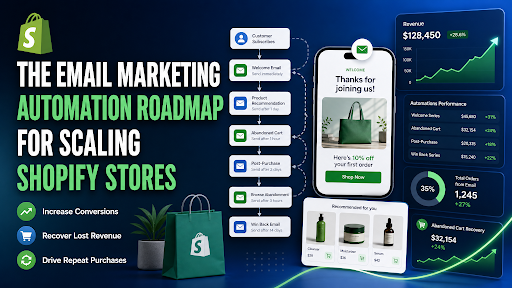
Scaling a Shopify store is no longer just about driving more traffic. The brands that grow profitably are the ones that convert more visitors, recover more lost revenue, and turn first time buyers into repeat customers. That is why email marketing automation has become one of the most important growth levers in ecommerce. According to Litmus, retail, ecommerce, and consumer goods brands can see an average email ROI of 45 to 1, making email one of the highest return channels available to modern online stores. Source
For Shopify merchants, this creates a clear opportunity. Email automation is not just a retention tool. It is a scalable revenue system that can support acquisition efficiency, improve customer lifetime value, and create more consistent growth across the full customer journey. Omnisend reports that automated emails drove 37% of sales from just 2% of email volume, which shows just how much revenue can come from behavior based flows when they are built correctly. Source
The challenge is that many stores either stop at basic flows or build too many disconnected automations without a strategic roadmap. To scale effectively, Shopify brands need the right sequence. They need to know which flows to launch first, how to structure them, and how to optimize them over time for stronger commercial performance.
Why email marketing automation matters for Shopify growth
As acquisition costs continue to rise, ecommerce brands cannot rely only on paid media to scale. If every sale depends on another round of ad spend, margins become harder to protect. Email automation changes that by helping brands monetize the traffic and attention they already paid for. It captures revenue from new subscribers, cart abandoners, active customers, and inactive buyers without requiring a new acquisition cost every time.
The performance gap between automated emails and standard campaigns makes the case even stronger. Omnisend found that automated emails generated $3.41 per email sent, compared with $0.155 for campaign emails. In the same benchmark set, automated emails converted at 1.49%, while campaign emails converted at 0.08%. That means automations generated about 22 times more revenue per email and nearly 19 times higher conversion than regular campaign sends. Source
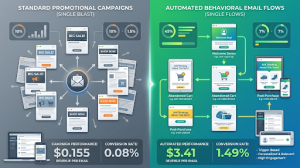
For a scaling Shopify store, that difference is significant. It means email automation is not just improving communication. It is improving the efficiency of the entire business.
Stage 1: Build the right foundation before scaling
Before launching advanced email marketing automation, Shopify brands need a clean foundation. That means strong subscriber capture, reliable Shopify integration, accurate event tracking, and useful customer segmentation.
Your signup forms should not simply collect email addresses. They should qualify intent and set expectations. Whether the offer is a first order discount, early access, product education, or subscriber only perks, the goal is to attract the right audience, not just a bigger list.
At the same time, your email platform needs to sync properly with Shopify so automations can trigger from product views, cart events, checkout starts, purchases, category interest, and customer lifecycle behavior. The better the data, the more relevant the automation.
This stage may feel less exciting than launching revenue flows, but it is what makes every later automation more effective.
Stage 2: Launch the highest impact revenue flows first
Once the foundation is in place, Shopify brands should start with the automations most likely to generate immediate return.
Welcome flow
The welcome flow is often the first real brand experience a subscriber gets after joining your list. It should do far more than deliver a discount code. A strong welcome sequence introduces the brand story, communicates the value proposition, highlights best sellers, and removes friction from the first purchase decision.
This flow matters because new subscribers usually have the highest short term intent. Omnisend reports that welcome emails generated $6.16 per email, with a 35.53% open rate and a 2.11% conversion rate. For many Shopify stores, this makes the welcome flow one of the most profitable automations in the stack. Source
Abandoned cart flow
Cart abandonment is one of the biggest revenue leaks in ecommerce. Klaviyo notes that 7 out of 10 shopping carts get abandoned, which means most stores are losing a large share of ready to buy intent unless they have a recovery flow in place. Source
A strong abandoned cart sequence should remind shoppers what they left behind, reinforce trust, address hesitation, and make it easy to complete the purchase. Omnisend reports that abandoned cart emails generated $3.59 per email with a 1.72% conversion rate, making them one of the most valuable ecommerce automations available. Source
Browse abandonment flow
Not every high intent shopper adds a product to cart. Many browse key products or collections, compare options, and leave. Browse abandonment emails help re-engage these visitors before buying intent fades.
This flow is especially important for Shopify brands with larger catalogs, premium products, or longer consideration cycles. It keeps the conversation going before the customer disappears from the funnel.
Stage 3: Use post purchase automation to increase repeat purchases
Acquiring a customer is only the beginning. Real ecommerce scale happens when first time buyers become repeat buyers. That is why post purchase automation is essential.
Post purchase flow
The post purchase flow should reassure customers, confirm value, reduce buyer anxiety, and improve the ownership experience. Depending on the product, it can include shipping expectations, usage tips, care instructions, customer support information, and personalized recommendations.
A strong post purchase sequence does more than improve experience. It also lays the groundwork for stronger retention, fewer support issues, and higher trust in the brand.
Second purchase flow
The second purchase is one of the most important milestones in ecommerce retention. Shopify stores that want to scale profitably should build specific automations designed to move new buyers toward their next order. This can include replenishment reminders, category based recommendations, bundles, or logic driven follow ups based on the first purchase.
Review request flow
Review request emails help generate the social proof that drives future conversions. When timed correctly, they support both retention and acquisition by turning past buyers into visible validators of the brand.
Stage 4: Add lifecycle segmentation and smarter personalization
As a Shopify store grows, broad messaging becomes less effective. A new subscriber should not receive the same messaging as a repeat buyer. A VIP customer should not be treated the same as a disengaged contact who has not interacted in months.
Litmus reports that 59% of companies analyze customer engagement metrics such as opens, click through rate, and bounce rates to evaluate email marketing, while 41% directly attribute revenue to email campaigns and 39% assess email impact on customer retention or loyalty. That shows how mature brands are increasingly treating email as a measurable business system, not just a communication channel. Source
For Shopify merchants, that means segmentation should evolve with the business. Your flows should respond to what customers viewed, what they bought, how often they buy, and how recently they engaged. That is what turns automation into a true lifecycle engine.
Stage 5: Optimize email automation continuously
One of the biggest mistakes in ecommerce email marketing is assuming that flows are finished once they are live. In reality, automation should be managed like an active revenue asset.
Subject lines, send timing, creative hierarchy, offer strategy, CTA placement, cadence, and product selection all influence results. Small improvements in click rate or conversion rate can compound into major revenue gains over time.
Klaviyo reports that the companies it analyzed brought in more than $50 million in Q4 using automation across common flows such as welcome series, abandoned cart, browse abandonment, and customer winback emails. That level of performance does not come from set and forget execution. It comes from continuous optimization. Source
Stage 6: Align email automation with your full ecommerce strategy
The best Shopify email programs do not work in isolation. They reinforce paid acquisition, onsite conversion, SMS, customer experience, merchandising, and retention planning.
If paid traffic is landing on a hero collection, the welcome sequence should continue that message. If customers often hesitate because of shipping or product fit, the email journey should resolve those objections earlier. If the brand is focused on repeat purchase growth, post purchase and reactivation flows should reflect that goal directly.
This is what separates stores that send emails from stores that build an automated revenue system.
Final thoughts
The business case for email automation is already clear. Litmus reports that 35% of marketing leaders receive between $10 and $36 in return for every $1 spent on email, 30% receive between $36 and $50, and 5% receive more than $50. For retail, ecommerce, and consumer goods brands, the reported average ROI reaches 45 to 1. Source
At the same time, Omnisend shows that automated emails can drive 37% of sales from just 2% of email volume, and that automations dramatically outperform standard campaigns in revenue per email and conversion rate. For Shopify stores that want to scale efficiently, those are not small advantages. They are strategic growth signals. Source Source
That is exactly where a specialist partner can create outsized value. Strategy, flow architecture, segmentation, revenue attribution, and testing all need to work together if email is going to become a consistent growth engine.
If you want to turn email marketing automation into a predictable revenue engine for your Shopify store, ecommerce today can help you build the right roadmap from the ground up.
From welcome flows and abandoned cart recovery to lifecycle segmentation, retention strategy, and performance optimization, ecommerce today helps Shopify brands create email systems that do more than send messages. They drive measurable ecommerce growth.
Get in touch with us at: [email protected]
FAQ
What are the most important email automations for Shopify stores?
The most important email automations for Shopify stores usually include a welcome flow, abandoned cart emails, browse abandonment, post purchase emails, second purchase flows, and winback campaigns. These automations cover the most commercially important moments in the customer journey and help brands recover lost revenue, improve retention, and increase customer lifetime value. Source Source
How much revenue can email automation generate for ecommerce brands?
Official benchmark data suggests that email automation can drive disproportionately strong revenue compared with standard campaigns. Omnisend found that automated emails generated $3.41 per email sent versus $0.155 for campaign emails, while automated emails also converted at 1.49% compared with 0.08% for campaign sends. Omnisend also reports that automated emails drove 37% of sales from just 2% of email volume. Source Source
Why is abandoned cart automation so important for Shopify stores?
Abandoned cart automation matters because a large share of ready to buy shoppers leave before checkout is completed. Klaviyo states that 7 out of 10 shopping carts get abandoned, which means stores without a cart recovery flow are likely leaving significant revenue on the table. Source
How often should Shopify brands optimize their email flows?
Shopify brands should treat email automation as an ongoing performance channel, not a one time setup. Flows should be reviewed regularly for subject lines, timing, offer strategy, click performance, conversion rate, unsubscribe rate, and revenue per email. Brands that test and refine consistently are more likely to improve lifecycle performance over time. Source Source